The Crusaders drag their booty back to town where the citizens of Sandpoint greet them with cheers. The very next day the town holds its first Swallowtail Festival in thirteen years as a celebration.
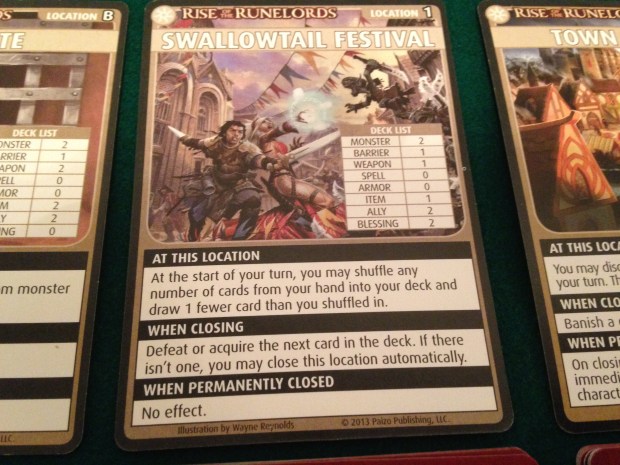
The Crusaders drag their booty back to town where the citizens of Sandpoint greet them with cheers. The very next day the town holds its first Swallowtail Festival in thirteen years as a celebration.
“…but we came here to help them!” pleads Seelah the Paladin.
“We have been in this region too long. There are many far lands to explore.” says Amiri the Barbarian.
“My pets are missing the forests.” says Lini the Druid.
Sajan the Monk is silent. His arms are folded.
The Crusaders (that’s the name of my new party – they were recruited by Seelah the Paladin to clean up the Lost Coast) have got rid of the local bandits and make their way into the town of Sandpoint for some well-earned rest. Unfortunately, someone is poisoning people and suspicion has fallen on Pillbug Podiker the local alchemist who has gone into hiding leaving poison traps all over town.
I have started from the beginning with my new party in the ‘Perils of the Lost Coast’ Adventure.
The party is made up of the Paladin, Barbarian, Druid and Monk.
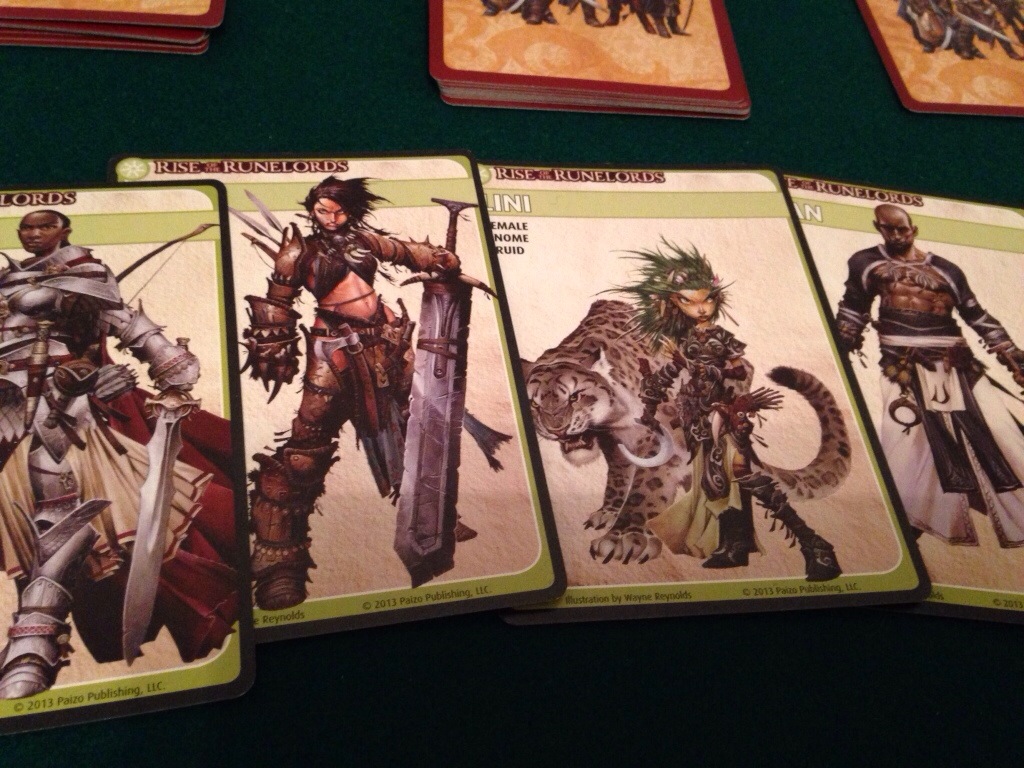
It is interesting because the balance of the party is quite different, and it isn’t immediately obvious how to play each of the characters. I am very familiar with the classic Fighter/MU/Cleric/Thief combo but these new four don’t exactly fit the same roles and need much more thought.
For example, the Paladin is basically a fighter-type but it seems both the Barbarian and Monk are better at thumping things. The Druid is sort of equivalent to a Wizard, i.e. weak with loads of spells, but she can pump her strength and dexterity checks. If she has an animal ally she is quite tough for a spellcaster.
New classes do have to be different in flavour and play-style, otherwise there would be no point, but it will definitely take some time to get a handle on them.
However, I have noticed they are low in intelligence skills, so essentially they are just a bunch of thickies roaming the Lost Coast looking for trouble.

I probably used up a fortune in color ink. Now I need to cut them out and fold and glue them. I am hoping they will be stiff enough to stand up. Maybe I can stick them to a piece of card. I could fold them around the edge of the card so they would still line up. I also fancy cutting around the edges so they have a silhouette.
My plans is to use the plastic stands from the Arkham Horror investigators. We don’t need them for AH, because we have all the investigator figures.
Reaper miniatures do a range of Pathfinder figures that includes all these characters, but I think painting figures is overkill when they aren’t really used in the game except as semi-abstract positional tokens.
Was thinking about getting the proper Pathfinder RPG beginner box, mainly to see what the RPG is like, but also to get the pawns which I could use in the card game. Also thought of getting the full Pathfinder RPG rules, but it is HUGE.
Then I saw that this guy has done nice standees, so I will make these instead:
http://boardgamegeek.com/filepage/94381/pacg-standups-with-scaled-mirrored-characters
I may still get the full rules out of interest. And maybe the Rise of the Runelords RPG campaign book. Might be fun to read that after playing the card game.
The way the Pathfinder Adventure Card Game works, your character’s deck is also their health. If you have to draw a card and your deck is empty, then you die. Its a bit like Magic The Gathering.
Typically, this happens at the end of your turn when you refresh your hand, and so the effect of this is to make characters with larger hand sizes weaker. They are more powerful in that they have more cards to do things with (items, spells, weapons, etc), but they are also more vulnerable.
Here is how it works: Each character has a deck of 15 cards. At the start of the game, they draw a hand based on their hand size. The fighter has a hand size of 4 cards, the cleric and rogue have 5 and the sorceress has 6.

As you do stuff in the game, you use up your cards by playing them. Typically, this means either discarding them to your discard pile, or ‘recharging’ them by putting them back on the bottom of your deck. You also lose cards by taking damage in a fight or from a trap. One hit of damage is one card discarded from your hand. If you run out of cards to discard from your hand, that’s ok because any extra are ignored.
It is quite good that you can never take more damage at a time than you have cards in your hand, but this is very, very deceptive. It is too easy to lose track and suddenly be at risk of death. If you empty your hand due to taking a bunch of damage, you will then have to draw your full hand size at the end of your turn, so you had better still have enough cards in your deck!
Suppose you are a fighter. You draw your starting hand of 4 cards. This leaves 11 in your deck. You are safe so long as you have at least 4 cards remaining, which means you can lose 7 cards by discarding either through use or damage before you are in danger.
Compare this to the sorceress. She starts with 6 cards in her hand. This leaves 9 in her deck. She needs to keep 6 cards in her deck to be safe, which means she can only discard 3 cards before she is at risk.
You can see how this system fits with the classic D&D flavour. Fighters are simple but tough. Wizards and sorceresses are powerful but weak.
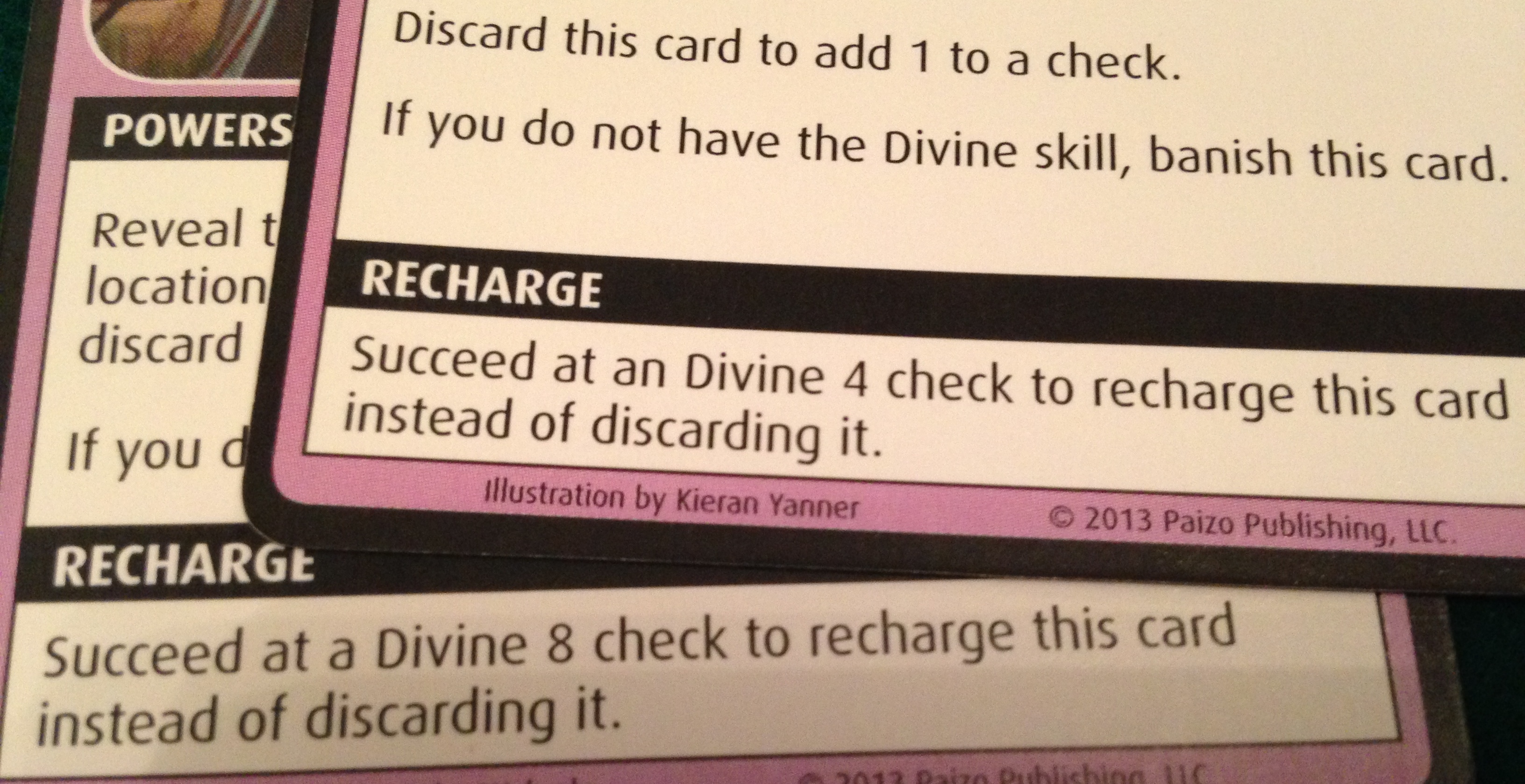
I did also mention recharging, where you put a card back in your deck instead of discarding it. This is vital to maintaining your character’s survivability. Every recharge is one hit point saved. If you can get your character to a state where you are mainly recharging instead of discarding (either through choice of equipment or abilities) then you will find you can survive much longer. This is particularly relevant for spells, since spell casters tend to be weak.
Lastly, always, always, always watch your deck count. Short deck equals dead adventurer and we really don’t want that 🙂
Now I have the character add on pack, I shall start a new party from scratch. Then come back to my first party, or merge them if they get to matching levels.
Haven’t tried the wizard, bard or the dwarf from the base set. The add-on pack has a druid, barbarian, paladin and monk.
These sound much more exciting, although it would probably be fun to try the other base set characters anyway.
So, I need to print out the character sheets so I can record the current party decks. And take the Set 1 cards out of all the decks, so I can restart with the base adventure.
Could even include one of my current party in the new party. This would be like leveling in a video game, ha ha.
Could also grind for better boons which seems completely insane. Is it insane? People do grind and level up characters for hours in video games.
I guess the insane bit is that this is a board game, so if you want to level up or have a particular item, you can just go ahead and pick that card.
Would still feel wrong to do it. I guess boardgamers have non-cheating in their DNA.
The Pathfinder Adventure Card Game (PACG) is the best ‘no-Dungeon Master’ fantasy board or card game you are going to get. It could even be a new type of card game altogether.

It isn’t a plain card game like Munchkin where you play the cards you draw from a central deck.
It isn’t a trading card game like Magic where you build your deck from whatever cards you can collect.
It isn’t a Living Card Game like Call of Cthulhu or Lord of the Rings where you build your deck from a universal pool.
The closest is probably a deck-building game like Thunderstone or Dominion where you improve your deck of cards during the game by adding new cards to a basic deck. However this has a new twist where you keep your character’s deck between games, and the deck gradually evolves and improves over a series of adventures, getting more powerful as your character grows.
The Pathfinder Adventure Card Game (PACG) has all the usual fantasy tropes, being based in the world of the full Pathfinder RPG, but the difference between this and other ‘no-DM’ fantasy boardgames such as Castle Ravenloft or Runebound, is that your character can grow and develop across a huge campaign of linked adventures. There are six adventure packs in the Rise of the Runelords adventure path and each of these packs will have five scenarios. So that is 30 different linked scenarios to complete, with the story of the Runelords campaign gradually unfolding as you go.
Way back in the mists of time, I used to play D&D and a bunch of other pen-and-paper role-playing games. There is nothing like having a character play through a whole series of adventures, collecting magical items and gaining new powers, and most of all building a history of narrow escapes and stupid mistakes and hard-won victories.
This game has the same thing. Your character grows and develops as you work your way through the scenarios. You get to choose their new abilities and powers as they gain experience. You get to tweak their equipment and spells with the new loot you find during adventures. You will get really attached to them, just like a regular RPG.
And here’s the kicker: Your character can die.
Yep, they can die. Done, gone, start again. It isn’t easy to get killed, and if you are worried and low on health you can just stop doing things for the rest of the game and this pretty much guarantees survival (although trying to win the scenario minus one party member will be hard). But it is possible to die.
Just imagine, after a few weeks you have completed two or three adventure packs and your Paladin is now kitted out with cool magic weapons and armour. Every time you start a new game you will always have in the back of your mind that She Could Die. It won’t be likely, but it could happen, and this is a fabulous bit of tension.
Honestly, for a role-player this game is superb.
Also there is no Dungeon Master, it is purely co-operative. The elegant mechanics of the game handle everything. Great for playing solo.
 Tim's Boardgames